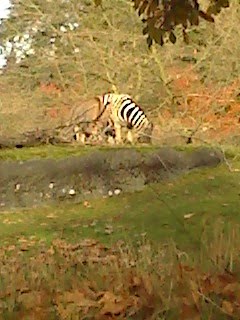
 I was reminded of Yann Martel’s “Life of Pi” and the concept of Zoomorphism when the first animals my daughter and I saw at the zoo were an oryx and a zebra standing side by side eating grass together. Zoomorphism is the concept of one species learning to see a member of another species as a part of its own or as a god. In the book he focuses on a lion seeing a dog as a mother figure, but his point is about a relational need. The lion cub needed a mother and the dog was willing. When I see these two animals sidling up to each other it’s inspiring. I wonder how their families feel about it? They occupy the same “savannah” so why not get along? Why not do more than get along, why not hang out? Maybe the two of them eating together will inspire the other animals to eat together too. At the very least the other animals will start to ask, “why are they hanging out?” If they ask that question maybe they will even try it.
An Oryx and a Zebra
What if the relational need is as simple as, “I want someone to spend time with?” Or I need a friend? Or, “we live in the same place why can’t we get along?” We live on the same planet, why can’t we get along? (you had to see that coming) Eventually you have to think it goes beyond just spending time together into a relationship of support, friendship, care, maybe even love (admittedly I may be reading a lot into an oryx and a zebra standing next to each other at the zoo, but often an image, a quote, a person inspires what it inspires regardless of what was actually there). For me every example set by those who are willing to see past differences is a good one and has that very potential to inspire. I have written about it before and I suppose I just get excited when I see it being lived out. It makes me wonder who the zebra is out there that I have never thought to stand with and it reminds me of how much simply standing together can do and how much more there is to learn by being together. I hope I never miss the chance to get to know those who are different from myself.
My daughter has a book called, “What if Zebras lost their stripes?” and it makes the case that even if they separated into some being black and some being white, “zebras are much to smart to let that come between them.” The story is told over and over again through things like this and the classic Dr. Seuss book “The Sneetches.” The fighting, the arguments the separations always seem silly when we’re through, but then we come back out of the story and into our lives the walls are still there. They are there and will be there until someone is willing to climb to the top and stand with someone from the other side of the wall for all to see so that the wall becomes a platform instead of a barrier. The walls are there until we are willing to look past it.
The oryx and the zebra give me hope that the walls won’t always be there and they remind me to climb up and to see beyond. Maybe it’s the zebras; I hope we can be as smart as the zebras.
 Tripping the Light Fantastic