Playing Games

The Roberts clan (my mom’s side of the family) is a family that gets together often and when we do we play. Day long games of monopoly, bingo complete with prizes, jeopardy, wheel of fortune, texas hold’um, you name it, as long as it’s a game that you have to think for, we play it (games of chance are not allowed). The point is we like games and more importantly we love each other, which makes playing together that much better. As a kid growing up my family used to go out to our cabin on Dow Mountain and the four of us would play games until the wee hours of the night. On road trips criss-crossing the country we seldom went to bed without a game of cards. My daughter is learning the family passion already as we play game after game of Candyland, Lady Bugs, Memory, Chutes and Ladders and Go Fish. This love of games extends beyond just the times when the whole family gets together too and every member just seems to have it in their DNA. I wasn’t surprised when I learned one cousin has a regular bridge night and whenever I gather like I did this week with my colleagues I make sure that one night at least is a game night.
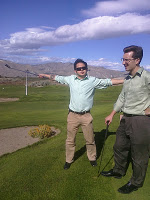
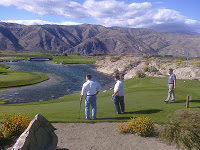
There is something very special for me about getting friends together to eat snacks that we rarely indulge in and to play. It has become a tradition each time we descend upon Wenatchee that one afternoon will be devoted to playing one of the nearby putting courses. A few years ago when I first attended the event, which brings together three hundred United Methodist clergy from Washington and Idaho, I didn’t know a lot of people. I was newly returned from graduate school and was just getting to know my colleagues and make a few friends. There wasn’t much time on the schedule that allowed for getting to know each other either, so we improvised. They had given us a tourist map of Wenatchee and there was an arrow on it that pointed to a “putting
course” somewhere off the map. At that point we weren’t sure what the difference was between
a putting course and mini-golf, but I managed to convince a few people to grab lunch to-go and use our precious little amount of free time to go try it out. The few I knew got a few more and I think eight of us went that first year. We ended up loving it so much we missed a session that I think talked about our retirement plan so we could play the entire course. It was and is a par 70 course of natural grass complete with water hazards and sand traps.

By the second year there were eleven of us and after seeing some of us having such a good time at lunch the Bishop had canceled the evening session so that we would have more time to do things like having fun together. Last year we even got the Bishop to come with us. This year 14 clergy played the course together including a number of new folks who were immediately hooked. Later that night many went out and had great fellowship at restaurants and such, but true to my DNA
I managed to get six to come and play games around a card table in the basement of my hotel that I had scoped out for that very purpose.
The beauty of playing games with people you don’t know all that well and people you enjoy being around is that time gets lost, you get to know each other in a different and I think more genuine way, and you laugh no matter how competitive you are. We played two games that were new for me, which makes it even better, and before we knew it we had been playing for four hours and it was almost 1am.
I believe that there are times which connect us. When a group of people works together, studies together, lives together and argues together, I don’t think the connection can be complete without playing together too and it makes all those other things better. When I was in Geneva a year and a half ago there were some awkward getting to know you moments that in their structured way started to open us up to each other, but it wasn’t until we started playing ping-pong, volley ball and UNO (which I was moved by that inner force in me to buy for the institute) that you got a sense we were finally connecting and building community. Maybe it’s about letting yourself be silly a little or maybe it’s getting in touch with some inner child in all of us, but whatever it is playing together is the root of joy. Even for those who don’t like board games and such it’s really just about playing and letting yourself play together. When we do, something real and I think beautiful comes out. It’s good to play.

Life Owes Me Nothing

“Life owes me nothing. Let the years

bring clouds or azure, joy or tears;
already a full cup I’ve quaffed;
already wept and love and laughed,
and seen, in ever-endless ways,
new beauties overwhelm the days.
Life Owes me nought. No pain that waits
can steal the wealth from memory’s gates;
No aftermath of anguish slow
can quench the soul fire’s early glow.
I breathe, exulting, each new breath,
Embracing Life, Ignoring Death.
Life owes me nothing, One clear morn
Is boon enough for being born;
and be it ninety years or ten,
No need for me to question when.
While Life is mine, I’ll find it good,
and greet each hour with gratitude.” -Author Unknown
In a world where we are often taught a sense of entitlement, it is when we learn we are entitled to nothing that we become free from disappointment and regret and truly open to joy and gratitude. Life may owe us nothing, but that shouldn’t keep us from trying to get everything out of it that we can. We need to “embrace life” and “greet each hour with gratitude.” When we find a place in our selves in which we can feel blessed by everything, it is in this place where we find the meaning of life. In the midst of tragic times it is the strength it teaches and the way love comes pouring in from every corner that keeps us grateful. In the midst of joyful times it is the humility, which allows us to see that joy as a gift not to be taken for granted that gives us cause for thanks.
We are all rich in blessings. Life owes us nothing, but rather we owe everything to life and must live it as fully as we can.

Hard Days-there is a next

This past Sunday I gave a sermon about faith as the hope that those things we desire are still possible even in the midst of our deepest despair. I talked about the rainy days we have quoting Longfellow’s poem “Rainy Days,”and about how easy it can be to slip into a form of despair where everything seems bad and we can’t seem to see good.

the day is cold, and dark, and dreary;
It rains, and the wind is never weary;
The vine still clings to the moldering wall,
But at every gust the dead leaves fall,
And the day is dark and dreary.

My life is cold, and dark, and dreary;
It rains, and the wind is never weary;
My thoughts still cling to the moldering Past,
But the hopes of youth fall thick in the blast
And the days are dark and dreary.

Be still, sad heart! and cease repining;
Behind the clouds is the sun still shining;
Thy fate is the common fate of all,
Into each life some rain must fall,

Some days must be dark and dreary.”

Little did I know how much I needed to hear that sermon myself. These past few days have been some of the hardest in my life. I am a very private person and I pride myself on being able to deal with stress, but we all have limits. I found out today that my mother has cancer that has reached stage 4. We will know more in the coming weeks and days, but you are never really ready to hear something like this. You want to be strong and you have to be, but there is nothing easy about it. There is a part of you that kind of has to disassociate, to compartmentalize things and focus either on other things or on only the facts as if they aren’t really happening to this person that you love. It’s easy to feel like it just isn’t fair, but that doesn’t help so you try to deal with things as best you can. You ask as many questions as you can think of knowing that you won’t like many of the answers, but knowing also that you need to hear them. Life as you knew it before has changed, but it must also still go on. One of my favorite shows of all time was the show “West Wing” and President Bartlett has this ability that no matter what was going on or how hectic things seem the question we have to ask is, “what’s next?” We can’t change what has happened, so we figure out what’s next. It’s not like asking the question makes the answers come easier, but asking the question is a refusal to just freeze and not do anything acknowledging that there is a next. Maybe that’s part of it; no matter what it is there is a next and once we face that there is another next and so on. There is a next.

Sweat

I have had the privilege of being invited to participate in a sweat on the Northern Cheyenne reservation near Coalstrip MT., the Monument Valley Navaho reservation in southern Utah and the Yakima reservation in Yakima, WA. Each time I was honored by the invitation to participate in something so rich in tradition and sacred for each tribe. The sweat can be a place of intense religious meaning where sacred moments and visions occur and it can also be a place to simply relax and share a time together. The other day I went into a hotel sauna just expecting to release some tension and do some cleansing, but what I ended up with was a sweat experience with a man from the Makah peoples of Neah Bay. Something about the atmosphere with the tension releasing steam and the mind clearing heat and sweat turns even a hotel sauna into that special place where sharing can occur. It’s funny because my experiences have all been in native american settings, but my mind also went to the ancient Roman baths with their steam rooms in which social barriers could be broken down, strangers could be friends and all manner of gossip could be heard. I confess that I didn’t do much sharing, but for the man I was with it was clear that the heat triggered something in him as he shared about the sweat he used regularly up in Neah Bay. He told me about his work since May on boats in the Gulf cleaning up oil and how he was glad to be home with his kids. His work took him away for months at a time and even now, with at least his part in the clean up done, he would be going off again soon to California or Alaska to work on other boats. He told me several times how he missed his kids as he boasted about their sports talent and told me about his wife’s art and how proud he is of her as well. He was clear that he needed to take these jobs to support his family and that a part of him loved it and felt like he formed new versions of family in every place and on each boat he worked, but you could hear some of the struggle in his voice. In the sweat he unburdened himself a bit and shared his pride in his family. In the sweat a sacred moment happened in the sharing. You never know what might happen in the sweat but you have to respect it. It’s good to sweat.

Eid

I had the great honor of being one of six Christians invited as observers to the Seattle area celebration of Eid al-fitr which marks the end of Ramadan. The celebration itself is an opportunity for muslims after a month of fasting to rejoice for the blessings they have gained during the fasting and is often a time to focus on charity and giving in thanks for those blessings. The gathering at the Washington Convention Center today brought together somewhere between 5000 and 8000 muslims from the region to pray and celebrate together.
People arrived in a steady steam for the event starting just before 9am. It was a bustle of activity as people greeted friends and family and found their way to a spot in the vast convention hall. As my small group of invited guests gathered in the lobby listening to the Adhan blaring through the loudspeakers calling everyone to prayer, we were quickly spotted by the press as outsiders and approached for interviews. They asked the obvious questions about the Mosque near ground zero and the pastor in Florida who might burn a Quran and what we might say to him. I appreciated one of my colleagues who simply asked that the pastor read the gospels again and see what it tells him. It was a nice chance for us as Christians to lift up our view, which is not always the one that gets portrayed and to be clear about our support. For me it was a chance to talk about shared beliefs and values like love of neighbor and peace as fellow children of Abraham and as “People of the Book,” a message which was reinforced by the speaker about an hour later. The call to prayer lasted for nearly an hour as they tried to get people into the hall and organized. As they made the call to line up for prayer (the iqama) we were ushered in to sit on a raised platform off to the side and near the back. It was an interesting perspective for us and gave us a view out over the entire hall. There was no mention of who we were or why were there, but people seemed to know anyway or at least to sense (and notice) that we had been set apart.

The prayer began around 10am and it was beautiful to watch as thousands of people prayed, bowed and prostrated themselves in unison. The men were in front and the women in back, a sea of colorful hijabs and flowing gowns, in near perfect lines moving up and down like waves. There is no jostling for position and even as late comers rushed to join in they were either melded into a line or they quickly formed a new one and got into the rhythm of things. The joyful exception to the lines were the hundreds of adorable children dressed in their best; some trying to partcipate and others just absorbing the atmosphere. For those who haven’t experienced it the prayer is not long but it can be powerful; especially in a vast hall with thousands all focused on one God together. In some places on Eid the prayer is followed by a message about unity or something along those lines while in others people simply pray then go off to be with family. Today’s message was about being the best neighbor you can be (this sounded oftly familiar to me as my own faith tradition teaches me the commandment to “love thy neighbor as thyself”). The speaker talked about Moses and Jesus and told a story about a Jewish neighbor reinforcing in numerous ways an ethic of love and compassion. He was clear that he was addressing a muslim audience, but the message rang out well beyond in it’s scope and as I said before it could have been given in many a church or synagogue without much change.

During the message many of the people got up to leave and we were overwhelmed, sitting on our raised dias, by the numbers of men, women and children who came over to thank us for being there and to express their sincere welcome and appreciation. I told one of my colleagues that it felt like Sunday after church when my church members file past me to shake my hand and to give their greetings and thanks for the message, only this time I hadn’t really done anything or at least I didn’t feel like I had. Obviously though to many of those gathered having us show up really was something. It was a precious moment as parents brought their kids to shake our hands and they offered us a message of peace and unity. It was after all why we were there. It wasn’t so much about witnessing the event, it was about simply being there to say, “we care, we support you and we are your neighbors” (keep in mind what we say about our neighbors).
I am profoundly thankful for the opportunity to be there and in a world where there is much that is misunderstood I am thankful for a chance to be clear even if just by my pressence. I have often said that it is much harder to hate someone when you know them and I think it is critical that we find ways to be together as individuals and as faith communities so that hate and ignorance can be defeated. All this weekend there are many more showing of love than hate going on and I hope those are what gets lifted up. We are neighbors and we all need to (as the speaker said) be the best neighbors we can be.